

Too many environmental issues cause bitter public controversy. The question of how to decommission California’s 27 offshore oil platforms started out as a typical example.
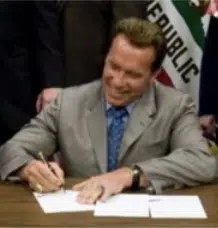
But remarkably, after careful analysis a single option, “rigs to reefs”, obtained the support of almost all stakeholders, including oil companies and environmentalists. A law to enable this option was passed by the California State house almost unanimously, and signed by Governor Arnold Schwarzenegger.
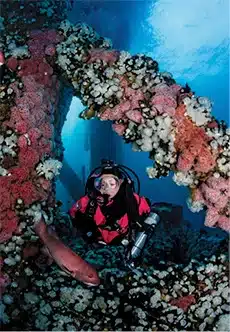 The 27 oil platforms in California’s coastal waters are at the end of their productive life after many decades. The original leases required the platform operators to dismantle and remove them entirely after they cease production.
The platforms are massive structures, up to 1200 feet deep. They are now encrusted with shellfish, coral, and other marine life, providing a rich habitat for economically valuable rock fish. They are popular with sea lions, recreational human divers, and many other creatures. Removal would be costly, over a billion dollars, with substantial environmental impacts, including emissions to air and water, as well as destruction of this habitat.
The California Ocean Science Trust (OST) commissioned an interdisciplinary team to provide a comprehensive survey of the relevant scientific, engineering, economic, and legal issues, with a decision analysis of the key decommissioning options. The study had to consider the concerns of a full range of stakeholders, including environmental groups, oil companies, commercial and recreational fishermen, divers, and a range of state and federal agencies.
These concerns include the cost of removal, environmental impacts on biological productivity, marine mammals and birds, air and water quality, and the seabed, ocean access, and compliance with the leases.
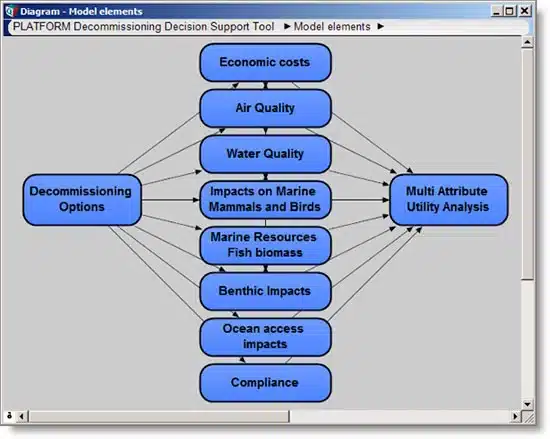
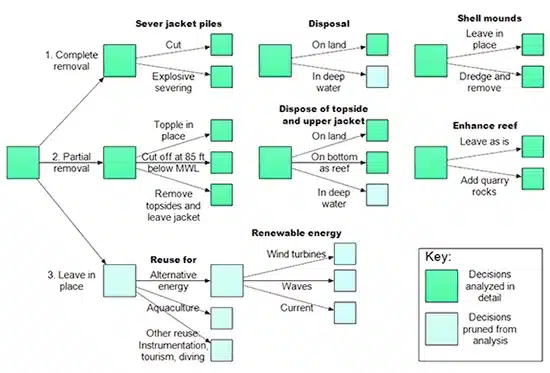
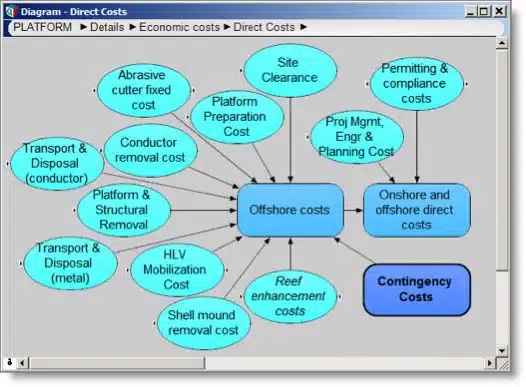
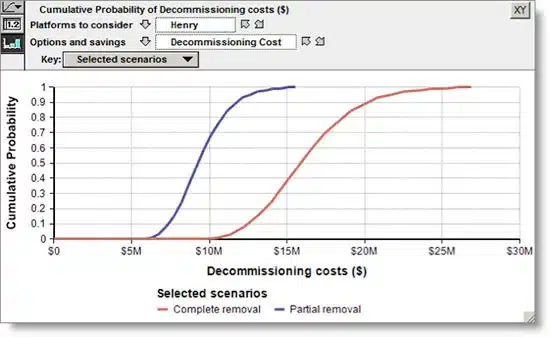
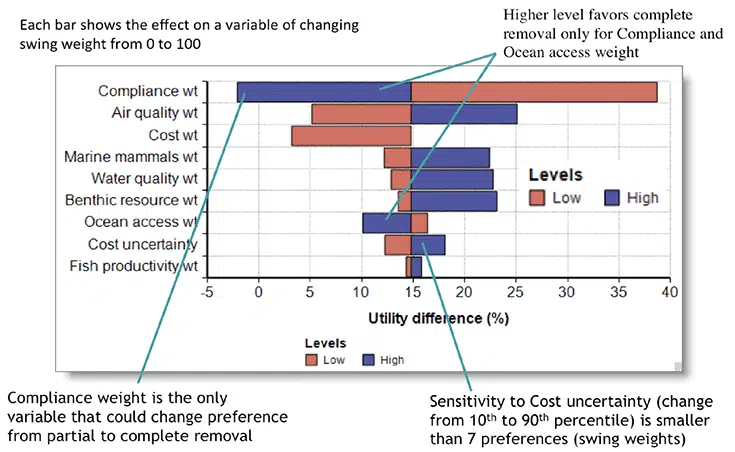
 A key insight from the study was that partial removal or “rigs to reefs” option reduced both costs and environmental impacts relative complete removal. Technical contributions included the first quantitative models of fish production and air emissions, and the first probabilistic analysis of decommissioning costs.
A key option for partial removal was to cut platforms off at 85 feet below sea level to avoid interfering with shipping. An additional option to sweeten partial removal for environmental advocates was to share the cost savings from partial removal (potentially over $500 million) between the oil companies and an Ocean Conservation Fund.
With this addition, almost all stakeholders supported the rigs-to-reefs. The California state legislature passed an enabling law, AB 2503, almost unanimously. Governor Arnold Schwarzenegger signed it in September 2010. Decommissioning of the first platforms is expected to start in 2015.